
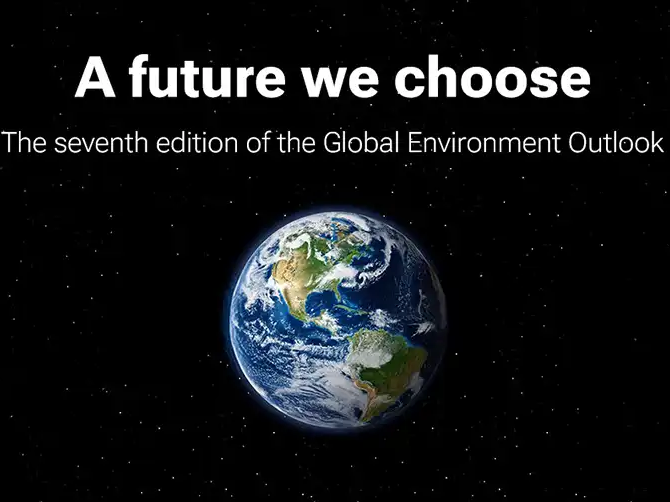
UNEP promotes its Global Environment Outlook 7 (GEO-7) report as “the most comprehensive scientific assessment of the global environment,” one “that compares the current trajectory of the global environment — one trending towards catastrophic climate change, the collapse of nature, and growing deadly pollution — with an alternative vision of the future.” Oddly, however, it says very little about the sustainable use of biodiversity, which is a core objective of the Convention on Biological Diversity (CBD), and, in particular, about the sustainable use of wild species as called for in Targets 5 and 9 of the Kunming-Montreal Global Biodiversity Framework (GBF).
Even though UNEP hosts the CBD Secretariat and promotes the GBF, the report is not organised by GBF goals and targets. Though it names some specific targets, such as 1, 2, 3, 7 and 10, these mostly concern habitat restoration or protection. In a 1,244-page report, the key targets on wild-species use are not mentioned at all. These are Target 5 on ensuring safe, legal, and sustainable harvesting and trade of wild species; and Target 9 on ensuring sustainable management and use that benefits people.
Rather than highlighting legal and sustainable use as part of its vision for the future, the report instead focuses on overexploitation and illegal trade as direct drivers of biodiversity loss, alongside land-use change, climate change, pollution, and invasive alien species. For example, the report emphasises:
Illegal wildlife trade continues to threaten biodiversity, and it affected 4,000 plant and animal species across 162 countries and territories from 2015–2021.
Direct exploitation of wildlife species can cause population collapses with cascading ecological consequences that are difficult to reverse.
The unsustainable exploitation of aquatic resources through overfishing, sand harvesting, and dredging threatens coastal and marine ecosystems, eroding their ability to produce food or contribute to economic development.
Indirect links to sustainable and legal harvesting and trade, as called for in Target 5, however, can be found in references to measures ensuring sustainable offtakes, such as the fishing quotas set by the European Union’s Common Fisheries Policy and New Zealand’s Quota Management System. There is also mention of a “sustainable hunting quota for customary subsistence uses” of bowhead whales by indigenous peoples in Alaska and Siberia.
Case studies throughout the report illustrate community-led sustainable use as a measure to deliver both conservation and livelihood outcomes. Livelihood outcomes relate directly to GBF Target 9, and GEO-7 makes some useful references without making the direct link. These include the traditional collection of non-timber forest products, including wild species, in the Western Ghats of southern India; Community-Based Natural Resource Management (CBNRM) in Namibia; community-based fisheries management in the Pacific Islands; and regulated livestock grazing in protected areas in Kenya.
In Chapter 18, on Solution Pathways, one of the actions proposed to strengthen ecosystem services is to “Establish a sustainable use of land, fresh water and oceans.” The focus, however, is not on the use of wild species but rather on biodiversity-friendly practices in agriculture, aquaculture, fisheries, and forestry, as called for in GBF Target 10. Here the report states that “Biodiversity conservation can be established not only in protected areas… but also in areas used for other economic activities.” The possibility of managing an area for the sustainable use of both domesticated and wild species is not raised at all.
In short, GEO-7’s vision of the future is positive in that it aims for practices that are biodiversity-friendly, but it could have gone further by explicitly envisioning practices that benefit people through the sustainable use of wild species.
By Francis Vorhies
Click here for the GEO-7 event taking place on 27 August 2026 in Geneva.